Recently I managed to loan the GFX 100RF from the Fujifilm House of Photography in London.
I’d actually pre-ordered the camera when it was announced, but then when my copy arrived a couple of weeks later I handled it I the shop, got cold feet, and walked away from it. But a couple more weeks later I needed to go to London for work, and the camera was available to loan while I was there, so I figured I’d give it a second chance.
This is not really a review of the camera, because I try to keep this site to image-making rather than gear; it’s more of a view of how it wants to be used and where it would lead me.

One of the key features of the 100RF is its aspect ratio dial, and this does invite some images that simply don’t come about with a fixed aspect ratio.
There are those who will say you can crop in post (and actually the vast 100MP canvas of the 100RF’s images does invite that too) but there is a world of difference when it comes to being able to compose to that frame when shooting. This is never more true than with the panoramic formats (65:24 and 17:6, which are so similar as to be somewhat redundant), where the final image is radically different to the native sensor.

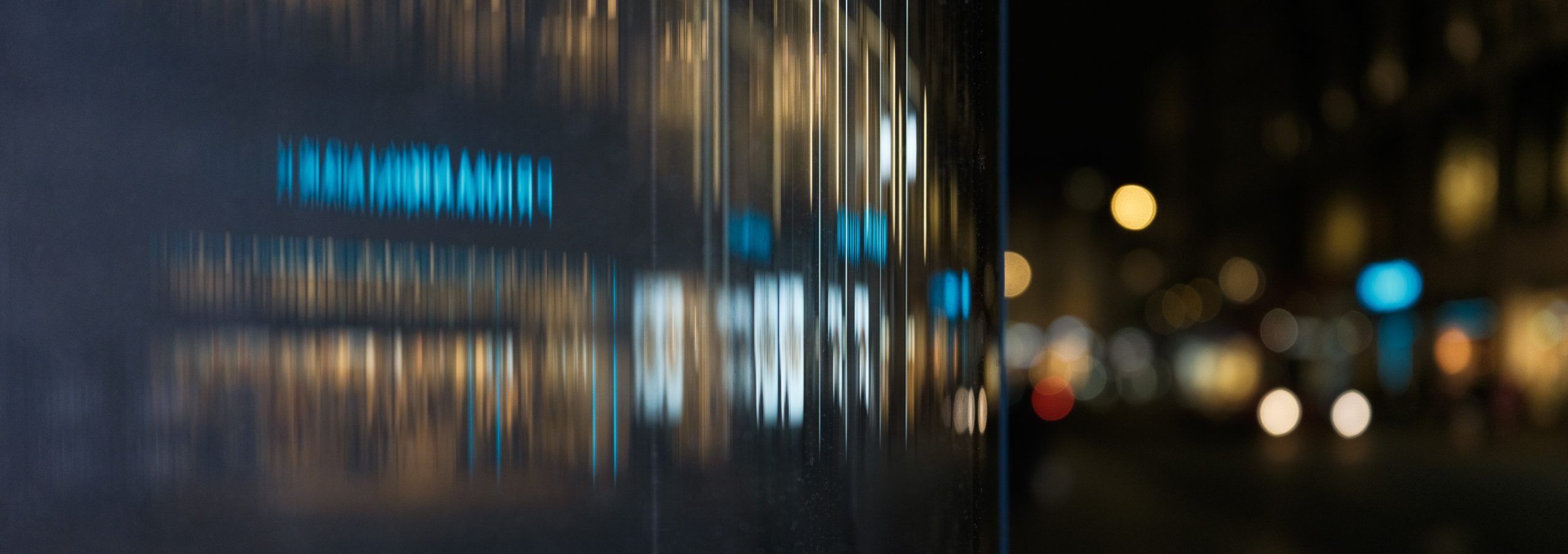
I am quite drawn to this format for my reflection composites. The width of the image draws in multiple scenes, while the vast resolution of the sensor delivers an extra level of detail. This adds to the layers of chaos in the images to really enrich that version of reality.
Of course, any image can be cropped to the same format, and actually I’ve since tried doing just that to images from the Ricoh GR III and they hold up quite well—but without access to those aspect ratios in the camera itself, it’s never occurred to me to do it.
I’ve always felt that digital cameras should offer real flexibility when it comes to aspect ratios, and I’ve always been baffled as to why they don’t. Of the ones I’ve tried, only the GFX range comes close to something satisfying in this regard. It’s a shame that it’s not implemented in a way that allows constant angle of view across aspect ratios, but at least there are several formats on offer beyond the usual suspects. I am a particular fan of 5:4, 7:6 and 17:6.


Of course, it’s not all about the aspect ratios and the dial that allows you to compose to the chosen format. It’s also about the sheer resolution that allows you to carve up the image later and pull completely new compositions from the full frame.
It’s something I’m in two minds about. On the one hand it’s an incredibly useful tool in the toolbox, and that’s especially true for street where it can be genuinely useful to quickly capture a moment and deal with composition later. But on the other hand, I don’t particularly like being tempted in to considering composition after the exposure is made. That’s not how I want to roll, and I don’t think it’s how I get my best results.
But, once you’re in that process, can really go for it. Even if you’re only using a quarter of the frame, you’re still getting pretty much the same resolution as the 26MP that most APS-C cameras afford, and it’s not that many years ago that 16MP seemed like a wild new frontier.
There are those who see the existence of medium format sensors solely as a means to the end of ultimate quality, for whom the 100RF’s concessions to its compact form are anathema. I am not one of them. When it’s inside the 100RF, the medium format sensor is what allows astonishing versatility from a remarkably compact and unfussy fixed-lens camera. This is not a full-size GFX crippled by a miniaturised lens, it is a compact camera with superpowers. Feel free to crop. This is one for the pragmatists.


As I alluded to earlier, the 100RF has some quirks and niggles.
Fujifilm changed their custom setting behaviour a few years ago, so it’s no longer quite as straightforward to configure and use “recipes” to style images out of the camera. The aspect ratio dial is virtually impossible to use with the camera to your eye; the focus mode lever absolutely so. The “zoom” rocker, which I tended to catch when moving my fingers to the exposure compensation dial, cannot be repurposed (it can be disabled in a roundabout way). The joystick that controls the AF point and navigates menus is, unlike the previous design that it inexplicably replaced, frankly horrible.
But the viewfinder is a delight. The screen is easy to flip out when required, and unlike most earlier Fujifilm cameras the 100RF can be configured to toggle between the screen and viewfinder. The AF performance is excellent (at least for my old school centre point focus-and-recompose technique). The dials and buttons and rings are all beautifully damped and solid-feeling. The grip at the front is just right in the hand. It’s a camera which for the most part just gets out of the way and lets you make images. Really detailed images.
The joy of a fixed lens camera, at least for the overthinkers among us, is that it throws questions in the bin. When you can’t change lenses, you can’t think about lenses. You don’t get stuck at home staring a pt a pile of primes thinking about what focal lengths you might use today; you don’t get the compositional laziness that a zoom lens can instil; you don’t contemplate whether buying a new lens would make everything better. You just go out and shoot.
The 100RF is a camera for that mindset. It just happens to also do everything that a bag full of primes or a zoom lens would do (well, sort of). It’s an overthinker’s dream.
As an overthinker, I’ve ordered one. (Again.)


